"...
that my story
is told truthfully ..."
About the life and work of Emilie Schindler
is told truthfully ..."
About the life and work of Emilie Schindler
Board 9
Slow Recognition and Late Homecoming
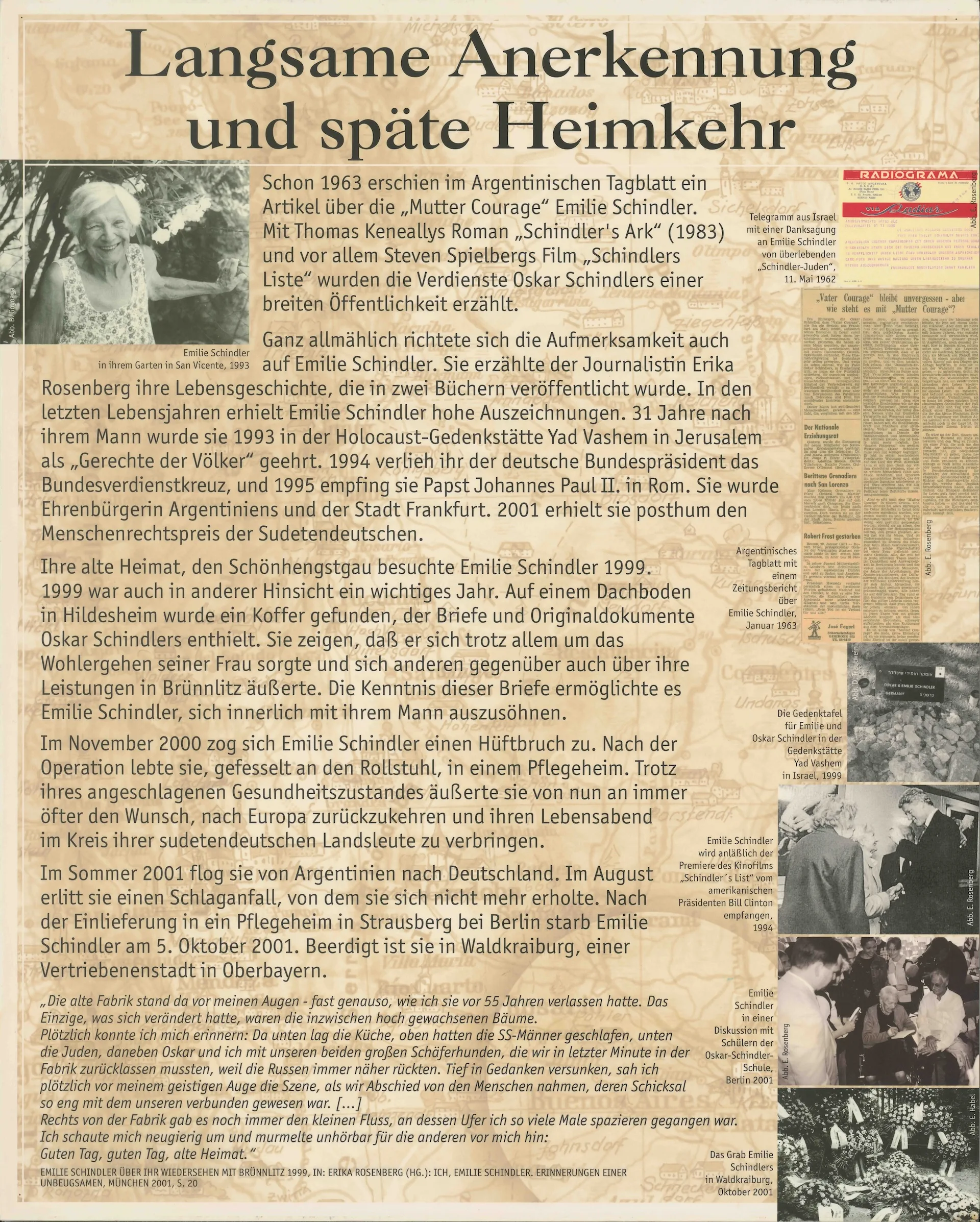
An article about “Mother Courage” Emilie Schindler appeared in an Argentinian daily newspaper as early as 1963. Thomas Keneally’s 1983 novel Schindler’s Ark and Steven Spielberg’s 1993 film Schindler’s List made Oskar Schindler’s achievements widely known to the public.
Over time, attention also turned to Emilie Schindler. She told her life story to journalist Erika Rosenberg, who published it in two books. Emilie Schindler received high honors in the final years of her life. In 1993, 31 years after her husband, she was recognized at the Yad Vashem Holocaust Memorial in Jerusalem as a “Righteous Among the Nations.”
The following year, the German Federal President awarded her the Federal Cross of Merit. In 1995, Pope John Paul II received her in Rome. She was made an honorary citizen of Argentina and Frankfurt am Main.
In 2001, she was posthumously awarded the Human Rights Prize of the Sudeten Germans.
In 1999, Emilie Schindler visited her old home in the Schönhengstgau region.
That year was important for another reason as well: a suitcase was found in an attic in Hildesheim containing letters and original documents from Oskar Schindler. These showed that, despite everything, Oskar had cared about Emilie’s well-being and had spoken to others about her efforts in Brünnlitz.
Learning about these documents helped Emilie reconcile with her husband emotionally.
In November 2000, she suffered a hip fracture. After surgery, she moved into a nursing home and used a wheelchair. Despite her poor health, she increasingly expressed her wish to return to Europe and spend her final days among her fellow Sudeten Germans.
In the summer of 2001, she flew from Argentina to Germany. In August, she suffered a stroke, from which she never recovered. After being transferred to a nursing home in Strausberg, near Berlin, Emilie Schindler passed away on October 5, 2001.
She is buried in Waldkraiburg, a town in Upper Bavaria known as a settlement for expelled Germans.
Emilie Schindler said the following about her visit to Brünnlitz in 1999:
“The old factory stood before my eyes, almost exactly as I had left it 55 years ago. The only thing that had changed were the trees, which had grown tall in the meantime.
Suddenly, I remembered: the kitchen was downstairs. The SS men slept upstairs, and the Jews slept downstairs, next to Oskar and me with our two big sheepdogs.
We had to leave the dogs behind in the factory at the last minute because the Russians were getting closer.
Deep in thought, I suddenly saw in my mind’s eye the moment we said goodbye to the people whose fate had been so closely linked to ours.
To the right of the factory was still the small river, along whose banks I had walked so many times.
I looked around curiously and mumbled softly to myself,
‘Good day, good day, old home.’
An article about “Mother Courage” Emilie Schindler appeared in an Argentinian daily newspaper as early as 1963. Thomas Keneally’s 1983 novel Schindler’s Ark and Steven Spielberg’s 1993 film Schindler’s List made Oskar Schindler’s achievements widely known to the public.
Over time, attention also turned to Emilie Schindler. She told her life story to journalist Erika Rosenberg, who published it in two books. Emilie Schindler received high honors in the final years of her life. In 1993, 31 years after her husband, she was recognized at the Yad Vashem Holocaust Memorial in Jerusalem as a “Righteous Among the Nations.”
The following year, the German Federal President awarded her the Federal Cross of Merit. In 1995, Pope John Paul II received her in Rome. She was made an honorary citizen of Argentina and Frankfurt am Main.
In 2001, she was posthumously awarded the Human Rights Prize of the Sudeten Germans.
In 1999, Emilie Schindler visited her old home in the Schönhengstgau region.
That year was important for another reason as well: a suitcase was found in an attic in Hildesheim containing letters and original documents from Oskar Schindler. These showed that, despite everything, Oskar had cared about Emilie’s well-being and had spoken to others about her efforts in Brünnlitz.
Learning about these documents helped Emilie reconcile with her husband emotionally.
In November 2000, she suffered a hip fracture. After surgery, she moved into a nursing home and used a wheelchair. Despite her poor health, she increasingly expressed her wish to return to Europe and spend her final days among her fellow Sudeten Germans.
In the summer of 2001, she flew from Argentina to Germany. In August, she suffered a stroke, from which she never recovered. After being transferred to a nursing home in Strausberg, near Berlin, Emilie Schindler passed away on October 5, 2001.
She is buried in Waldkraiburg, a town in Upper Bavaria known as a settlement for expelled Germans.
Emilie Schindler said the following about her visit to Brünnlitz in 1999:
“The old factory stood before my eyes, almost exactly as I had left it 55 years ago. The only thing that had changed were the trees, which had grown tall in the meantime.
Suddenly, I remembered: the kitchen was downstairs. The SS men slept upstairs, and the Jews slept downstairs, next to Oskar and me with our two big sheepdogs.
We had to leave the dogs behind in the factory at the last minute because the Russians were getting closer.
Deep in thought, I suddenly saw in my mind’s eye the moment we said goodbye to the people whose fate had been so closely linked to ours.
To the right of the factory was still the small river, along whose banks I had walked so many times.
I looked around curiously and mumbled softly to myself,
‘Good day, good day, old home.’