"...
that my story
is told truthfully ..."
About the life and work of Emilie Schindler
is told truthfully ..."
About the life and work of Emilie Schindler
Board 8
In Their New Home
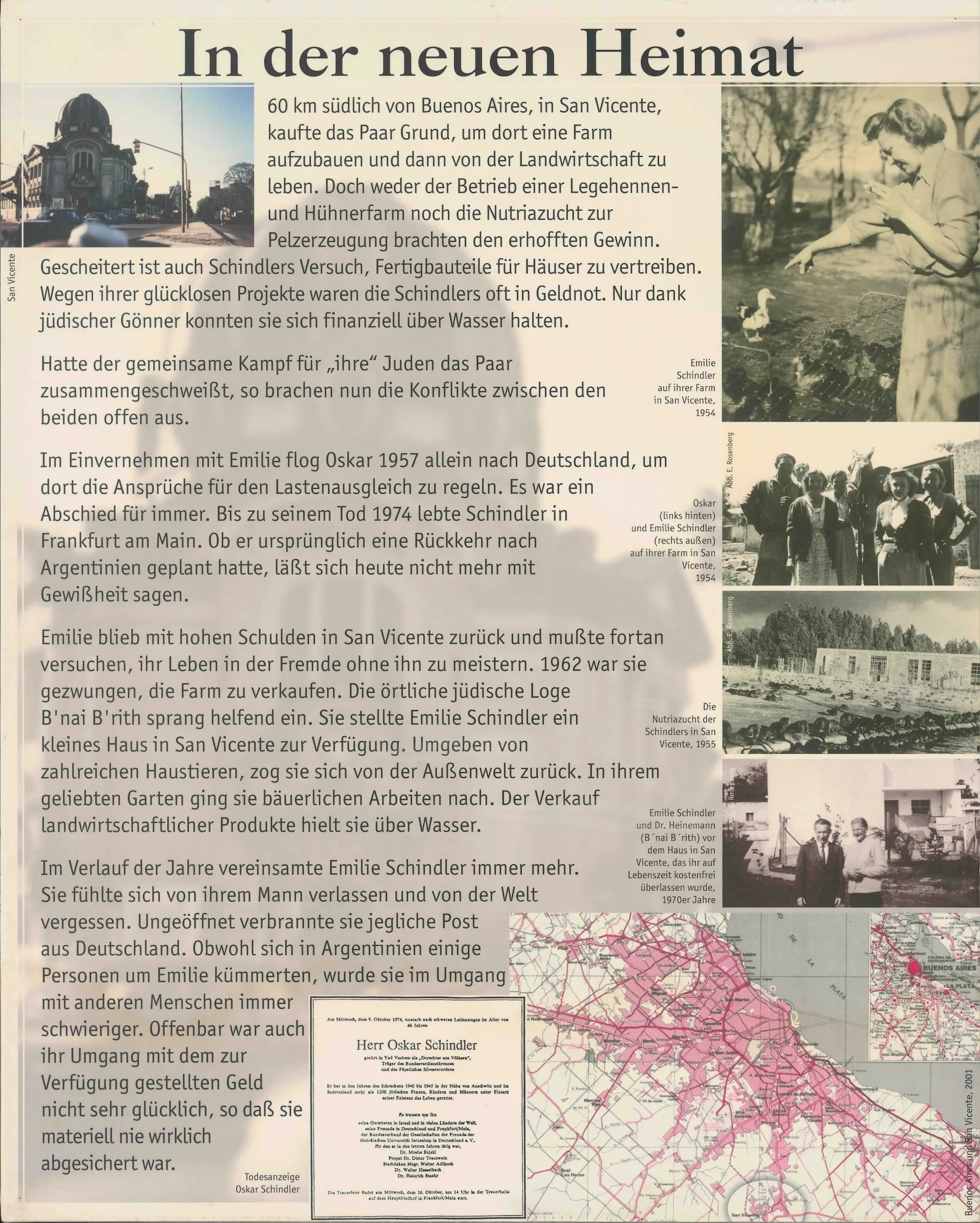
Sixty kilometers south of Buenos Aires, in San Vicente, the couple bought land to start a farm and make a living from agriculture. However, neither running a chicken and egg farm nor breeding nutria for fur turned out to be profitable. Schindler’s attempt to sell prefabricated house components also failed.
Because of their unsuccessful projects, the Schindlers were often short on money. They managed to survive financially only thanks to support from Jewish patrons.
While their shared struggle to save “their” Jews had brought them closer during the war, conflicts between the couple now broke out openly.
With Emilie’s agreement, Oskar flew to Germany alone in 1957 to settle compensation claims for wartime losses. It was a permanent farewell. He lived in Frankfurt am Main until his death in 1974. Whether he ever planned to return to Argentina remains uncertain.
Emilie stayed behind in San Vicente with significant debt and had to learn to manage life abroad without him. In 1962, she was forced to sell the farm. The local B’nai B’rith lodge stepped in and provided her with a small house in San Vicente.
Surrounded by many animals, she withdrew from public life and worked in her beloved garden. Selling agricultural products helped her make ends meet.
Over the years, however, she became increasingly lonely. She felt abandoned by her husband and forgotten by the world. She burned all unopened letters from Germany.
Although some people in Argentina cared for her, she became difficult to be around. She also seemed unhappy with the financial help she received, and she never felt financially secure.
Sixty kilometers south of Buenos Aires, in San Vicente, the couple bought land to start a farm and make a living from agriculture. However, neither running a chicken and egg farm nor breeding nutria for fur turned out to be profitable. Schindler’s attempt to sell prefabricated house components also failed.
Because of their unsuccessful projects, the Schindlers were often short on money. They managed to survive financially only thanks to support from Jewish patrons.
While their shared struggle to save “their” Jews had brought them closer during the war, conflicts between the couple now broke out openly.
With Emilie’s agreement, Oskar flew to Germany alone in 1957 to settle compensation claims for wartime losses. It was a permanent farewell. He lived in Frankfurt am Main until his death in 1974. Whether he ever planned to return to Argentina remains uncertain.
Emilie stayed behind in San Vicente with significant debt and had to learn to manage life abroad without him. In 1962, she was forced to sell the farm. The local B’nai B’rith lodge stepped in and provided her with a small house in San Vicente.
Surrounded by many animals, she withdrew from public life and worked in her beloved garden. Selling agricultural products helped her make ends meet.
Over the years, however, she became increasingly lonely. She felt abandoned by her husband and forgotten by the world. She burned all unopened letters from Germany.
Although some people in Argentina cared for her, she became difficult to be around. She also seemed unhappy with the financial help she received, and she never felt financially secure.