"...
that my story
is told truthfully ..."
About the life and work of Emilie Schindler
is told truthfully ..."
About the life and work of Emilie Schindler
Board 6
The Supply Network
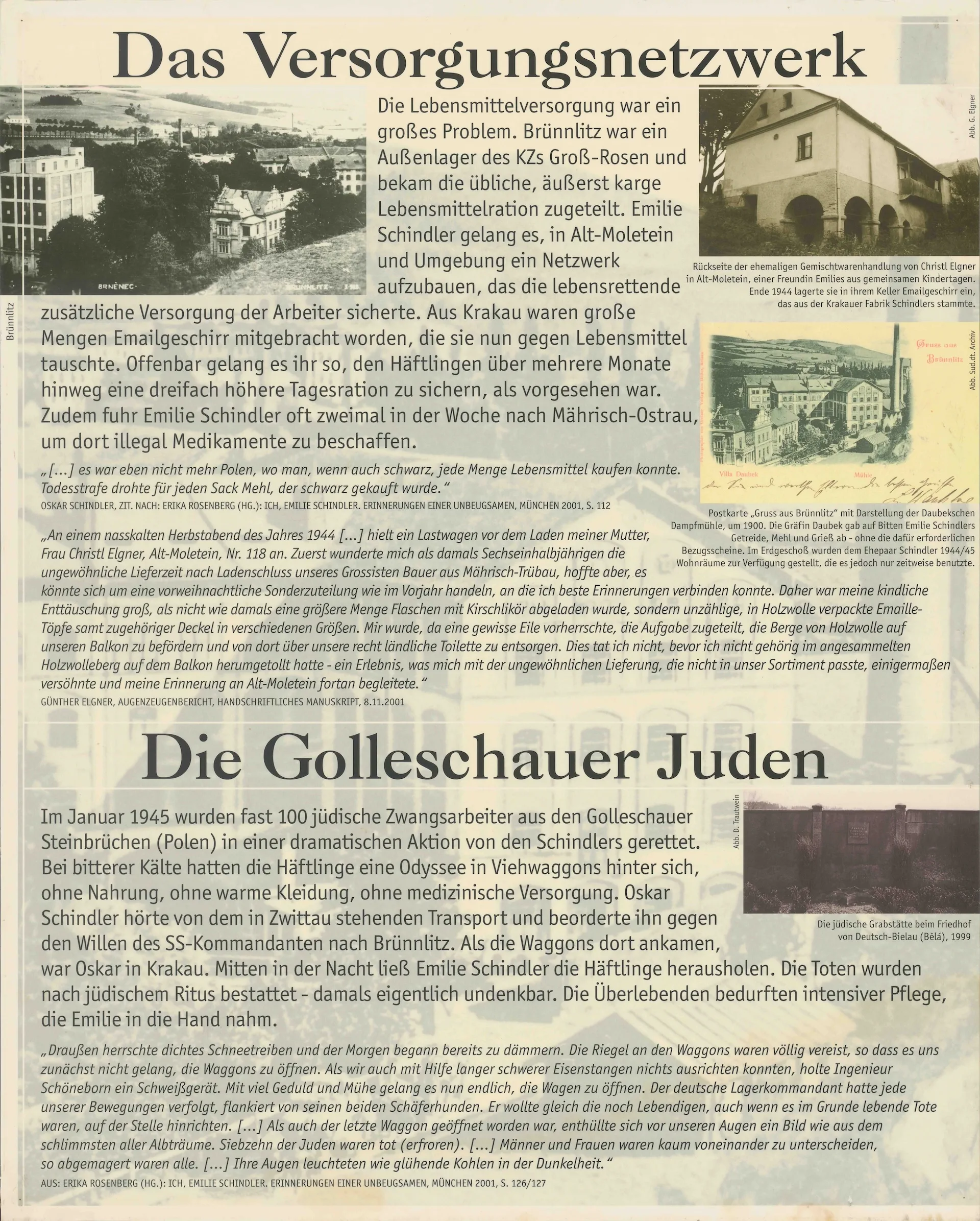
The food supply was a major problem. Brünnlitz, a satellite camp of the Groß-Rosen concentration camp, received the standard, extremely meager food rations. Emilie Schindler built a network in Alt-Moletein and the surrounding area that provided the workers with life-saving supplies. She had brought large quantities of enamel tableware from Krakow, which she now exchanged for food. This enabled her to provide the prisoners with three times their daily rations for several months. Additionally, Emilie Schindler traveled to Moravian Ostrava twice a week to illegally procure medicine.
Quote from Oskar Schindler:
“[…] It was no longer Poland, where you could buy any amount of food, even on the black market. There was a death penalty for every sack of flour bought illegally.”
Eyewitness Report by Günther Elsergen
“On a cold and wet autumn evening in 1944, a truck stopped in front of my mother’s store, Christl Elgner, at Alt-Moletein No. 118. As a sixteen-and-a-half-year-old, I was surprised by the unusual delivery time, considering that our wholesaler, Bauer from Mährisch-Trübau, had already closed. However, I hoped it might be a special pre-Christmas delivery like the previous year, which I fondly remembered. So I was disappointed when, instead of a large quantity of bottles of cherry liqueur, countless enamel pots wrapped in wood wool with lids of various sizes were unloaded. I was in a bit of a hurry and was given the task of transporting the mountains of wood wool to our balcony and disposing of it via our rather rustic toilet. However, I didn’t do this until I had played around in the pile of wood wool on the balcony, which somewhat reconciled me with the unusual delivery. It didn’t fit into our range and became part of my memories of Alt-Moletein from then on.”
The Jews of Golleschau
In January 1945, Oskar and Emilie Schindler rescued almost 100 Jewish forced laborers from the Golleschau quarries in Poland in a dramatic operation.
The prisoners had endured an odyssey in cattle wagons in the bitter cold without food, warm clothing, or medical care. Schindler learned about the transport in Zwittau and ordered it to be redirected to Brünnlitz, despite the SS commander’s objections. When the wagons arrived, Oskar was in Krakow. Emilie Schindler took the prisoners out in the middle of the night. The dead were buried according to Jewish rites, which was unthinkable at the time. The survivors required intensive care; many of them were close to death.
Quote from Emilie Schindler:
“It was snowing heavily outside, and morning was beginning to break. The bolts on the wagons were completely iced over, so we were unable to open them at first. After failing to open them with long, heavy iron bars, engineer Schöneborn fetched a welding machine. After much patience and effort, we finally managed to open the wagons. The German camp commander observed our every move, flanked by his two sheepdogs. He wanted to execute those who were still alive on the spot, even though they were essentially the living dead. When we opened the last wagon, we saw a scene from the worst nightmare. Seventeen Jews were dead, frozen to death. Men and women could hardly be distinguished from one another because they were all so emaciated. Their eyes shone like glowing coals in the darkness.”
The food supply was a major problem. Brünnlitz, a satellite camp of the Groß-Rosen concentration camp, received the standard, extremely meager food rations. Emilie Schindler built a network in Alt-Moletein and the surrounding area that provided the workers with life-saving supplies. She had brought large quantities of enamel tableware from Krakow, which she now exchanged for food. This enabled her to provide the prisoners with three times their daily rations for several months. Additionally, Emilie Schindler traveled to Moravian Ostrava twice a week to illegally procure medicine.
Quote from Oskar Schindler:
“[…] It was no longer Poland, where you could buy any amount of food, even on the black market. There was a death penalty for every sack of flour bought illegally.”
Eyewitness Report by Günther Elsergen
“On a cold and wet autumn evening in 1944, a truck stopped in front of my mother’s store, Christl Elgner, at Alt-Moletein No. 118. As a sixteen-and-a-half-year-old, I was surprised by the unusual delivery time, considering that our wholesaler, Bauer from Mährisch-Trübau, had already closed. However, I hoped it might be a special pre-Christmas delivery like the previous year, which I fondly remembered. So I was disappointed when, instead of a large quantity of bottles of cherry liqueur, countless enamel pots wrapped in wood wool with lids of various sizes were unloaded. I was in a bit of a hurry and was given the task of transporting the mountains of wood wool to our balcony and disposing of it via our rather rustic toilet. However, I didn’t do this until I had played around in the pile of wood wool on the balcony, which somewhat reconciled me with the unusual delivery. It didn’t fit into our range and became part of my memories of Alt-Moletein from then on.”
The Jews of Golleschau
In January 1945, Oskar and Emilie Schindler rescued almost 100 Jewish forced laborers from the Golleschau quarries in Poland in a dramatic operation.
The prisoners had endured an odyssey in cattle wagons in the bitter cold without food, warm clothing, or medical care. Schindler learned about the transport in Zwittau and ordered it to be redirected to Brünnlitz, despite the SS commander’s objections. When the wagons arrived, Oskar was in Krakow. Emilie Schindler took the prisoners out in the middle of the night. The dead were buried according to Jewish rites, which was unthinkable at the time. The survivors required intensive care; many of them were close to death.
Quote from Emilie Schindler:
“It was snowing heavily outside, and morning was beginning to break. The bolts on the wagons were completely iced over, so we were unable to open them at first. After failing to open them with long, heavy iron bars, engineer Schöneborn fetched a welding machine. After much patience and effort, we finally managed to open the wagons. The German camp commander observed our every move, flanked by his two sheepdogs. He wanted to execute those who were still alive on the spot, even though they were essentially the living dead. When we opened the last wagon, we saw a scene from the worst nightmare. Seventeen Jews were dead, frozen to death. Men and women could hardly be distinguished from one another because they were all so emaciated. Their eyes shone like glowing coals in the darkness.”